
Platelet Counts in Dengue: Which Numbers Matter and Which Panic Is Wasted
Dr. Khanna's X-Ray & Laboratory · 14 August 2026 · 3 min read
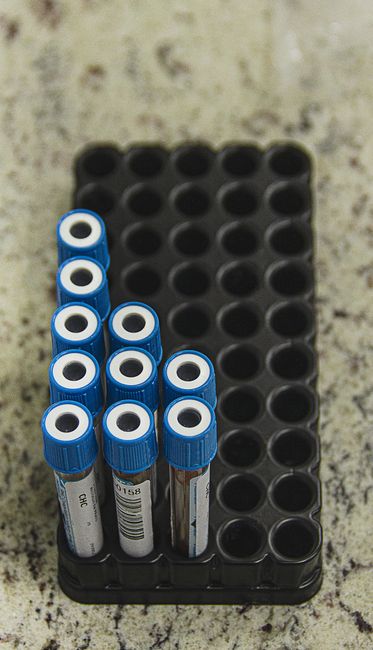
Nothing in dengue causes more panic than the platelet report
Nothing in a dengue household generates more anxiety than the daily platelet number, and much of that anxiety is aimed at the wrong part of the report. Platelets are tiny cell fragments that plug leaks in blood vessels, and a healthy count runs from about 150,000 to 450,000 per microlitre — Indian lab reports often print this as 1.5 to 4.5 lakh, a lakh being one hundred thousand. Dengue lowers the count in three ways at once: the virus suppresses the bone marrow factory that makes platelets, the immune response destroys circulating ones faster than usual, and some are consumed at the walls of inflamed, leaky vessels.
The expected shape of the fall
In a typical dengue illness the count starts drifting down around day three of fever and reaches its lowest point close to the time the fever breaks, between roughly day four and day six. This overlap is not a coincidence — the same immune storm that ends the fever is what drives platelet destruction and vessel leakiness, which is why doctors call this window the critical phase. A falling count during these days is the disease behaving exactly as described in every textbook, not a sign that treatment is failing. What doctors are really tracking is how steep the slope is and what the patient looks like while it happens.
Which numbers are routine and which get attention
Counts dipping to around 100,000, and often below it, are common in ordinary dengue that recovers uneventfully at home, so a single reading of 90,000 in a patient who is drinking, passing urine and comfortable is not an emergency. Doctors sharpen their attention when the count falls steeply between consecutive tests, drops below roughly 50,000, or keeps falling after the fever has settled. Platelet transfusion is not triggered by a number on its own: most hospital protocols reserve it for very low counts — often below 10,000 to 20,000 — or for active bleeding, because transfused platelets are consumed within hours by the same process that destroyed the original ones.
Why the trend beats any single reading
Automated counters become less accurate at low platelet levels and can under-read when platelets clump in the sample tube, which is why a surprising result is often rechecked on a peripheral smear — a technician actually looking at the blood under a microscope. Two labs, or the same lab twice in a day, can legitimately differ by tens of thousands. The clinically useful information is therefore the direction across days, read together with the haematocrit — the packed cell volume that rises when plasma leaks out of vessels and the blood concentrates. A modest count with a stable haematocrit is far more reassuring than a better count with a climbing one.
The panic that is wasted
Papaya-leaf juice, kiwi fruit and goat milk are pressed on every dengue patient in North India, and none of them has reliable evidence of changing the course of the illness — the count rises when the immune phase passes, whatever was eaten that morning, and the remedy gets the credit. Chasing a lab twice a day for repeat counts, comparing your number with a neighbour's, or panicking at 95,000 all spend energy that is better spent on fluids and observation. In the US, where dengue appears mainly in returning travellers and in Florida, Texas and the territories, the same rule holds: no food raises platelets, and hydration remains the actual treatment.
The signs that outrank every number
Severe continuous abdominal pain, persistent vomiting, bleeding from gums or nose, blood in vomit or stool, cold clammy limbs, unusual drowsiness or restlessness, and very little urine over six to eight hours are the recognised dengue warning signs, and every one of them matters more than the platelet figure. A patient with 110,000 platelets and constant abdominal pain needs a hospital tonight; a calm, hydrated patient at 60,000 may simply need tomorrow's repeat test. Plasma leakage — the thing that actually kills in dengue — is tracked by symptoms, blood pressure and haematocrit, and the platelet count is only one instrument on that dashboard.
The recovery bounce and when to stop testing
Once the critical window passes, the bone marrow releases a surge of young platelets and the count often climbs faster than it fell, sometimes overshooting normal for a few days — a rise of 30,000 or more in a day is common and welcome. An intensely itchy rash on the palms, soles and limbs frequently appears at this stage and is a classic sign of recovery, not relapse. Two consecutive rising counts with the patient eating, walking and passing urine normally usually mark the safe end of daily testing, though your doctor makes that call. Deep tiredness can linger two to three weeks after the numbers normalise; that is convalescence, not hidden disease.
Questions patients ask
Should we give papaya-leaf juice anyway, just in case?
If the patient tolerates it, small amounts are unlikely to harm, but do not let it substitute for what actually matters — fluids, paracetamol only, and watching for warning signs. Refusing hospital care because a home remedy is "raising the count" is where real harm happens.
My count is 90,000 — do I need admission?
Not on that number alone. If you are drinking well, passing urine every four to six hours, and have no warning signs, most doctors continue home care with a repeat count the next day. Admission decisions rest on symptoms, blood pressure and haematocrit trend, not one platelet figure.
How often should the CBC be repeated?
Usually once daily from around day three of fever until the count has clearly turned upward for two consecutive tests. Your doctor may ask for twelve-hourly tests if the fall is steep or warning signs appear — follow their schedule rather than testing on your own.
Suggested articles

Malaria, Dengue or Typhoid? Telling Monsoon Fevers Apart
Malaria, dengue and typhoid start almost identically. The fever patterns, companion signs and blood tests that separate the three monsoon fevers.
16 August 2026 · 3 min read
Fever in Children: A Parent's Hour-by-Hour Guide
An hour-by-hour plan for a child's fever: measuring properly, dosing by weight, what to watch overnight, and the red flags that end the waiting.
15 August 2026 · 3 min read
Viral or Bacterial? How Doctors Decide — and Why It Changes Treatment
How doctors tell viral from bacterial infections — story, timeline, examination and tests — and why the answer decides whether antibiotics help at all.
14 August 2026 · 4 min read